
When it comes to major U.S. industries, three tends to be the magic number.
Historically, auto manufacturing was long dominated by Chrysler, Ford and General Motors – the so-called “Big Three,” which at one point controlled over 60% of the U.S. auto market. A dominant trio shows up elsewhere, too, in everything from the U.S. defense market – think Lockheed Martin, Boeing and Northrup Grumman – to cellphone service providers (AT&T, T-Mobile and Verizon). The same goes for the U.S. airline industry in which American, Delta and United fly higher than the rest.
The rule of three also applies to what Americans watch; the glory days of television was dominated by three giants: ABC, CBS and NBC.
Now, in the digital age, we are rapidly moving to a “Big Three” dominating streaming services: Netflix, Amazon and Disney.
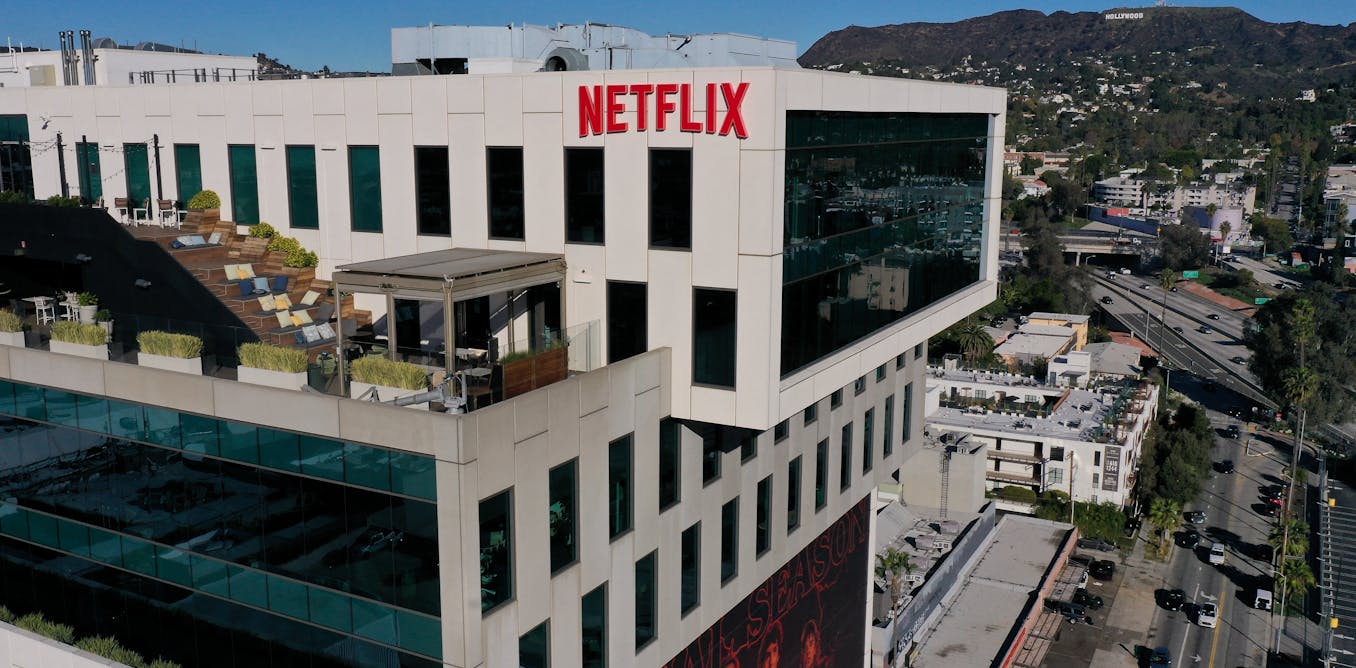
The latest step in that process is Netflix’s plan to acquire Warner Bros. for US$72 billion. If approved, the move would solidify Netflix as the dominant streaming platform.
When streams converge
Starting life as a mail DVD subscription service, Netflix moved into streaming movies and TV shows in 2007, becoming a first-mover into the sphere.
Being an early adopter as viewing went from cable and legacy to online and streaming gave Netflix an advantages in also developing support technology and using subscriber data to create new content.
The subsequent impact was Netflix became a market leader, with quarterly profits now far exceeding its competitors, which often report losses.
Today, even without the Warner Bros. acquisition, Netflix has a dominant global base of over 300 million subscribers. Amazon Prime comes second with roughly 220 million subscribers, and Disney – which includes both Disney+ and Hulu – is third, with roughly 196 million subscribers. This means that between them, these three companies already control over 60% of the streaming market.
Netflix’s lead would only be reinforced by the proposed deal with Warner Bros., as it would add ownership of Warner subsidiary HBO Max, which is currently the fourth-biggest streamer in the U.S. with a combined 128 million subscribers. While some of them will overlap, Netflix is likely to still gain subscribers and better retain them with a broader selection of content.
Netflix’s move to acquire Warner Bros. also follows prior entertainment industry consolidation, driven by a desire to control content to retain streaming service subscribers.
In 2019, Disney acquired 21st Century Fox for $71.3 billion. Three years later, Amazon acquired Metro-Goldwyn-Mayer for $8.5 billion.
Should the Netflix deal go through, it would continue this trend of streaming consolidation. It would also leave a clear gap at the top between the emerging Big Three and other services, such as Paramount+ with 79 million subscribers and Apple TV+, which has around 45 million. Paramount on Dec. 8, 2025, announced a hostile takeover bid for Warner Bros. in a proposed $108.4 billion deal that would, unlike the Netflix plan, include Warner Bros. subsidiary Discovery+.
Why industries come in threes
But why do industries converge to a handful of companies?
As an expert on mergers, I know the answer comes down to market forces relating to competition, which tends to drive consolidation of an industry into three to five firms.
From a customer perspective, there is a need for multiple options. Having more than one option avoids monopolistic practices that can see prices fixed at a higher rate. Competition between more than one big player is also a strong incentive for additional innovation to improve a product or service.
For these reasons, governments – in the U.S. and over 100 other countries – have antitrust laws and practices to avoid any industry displaying limited competition.
However, as industries become more stable, growth tends to slow and remaining businesses are forced to compete over a largely fixed market. This can separate companies into industry leaders and laggards. While leaders enjoy greater stability and predictable profits, laggards struggle to remain profitable.
Lagging companies often combine to increase their market share and reduce costs.
The result is that consolidating industries quite often land on three main players as a source of stability – one or two risks falling into the pitfalls of monopolies and duopolies, while many more than three to five can struggle to be profitable in mature industries.
What’s ahead for the laggards
The long-term viability of companies outside the “Big Three” streamers is in doubt, as the main players get bigger and smaller companies are unable to offer as much content.
A temporary solution for smaller streamers to gain subscribers is to offer teaser rates that later increase for people that forget to cancel until companies take more permanent steps. But lagging services will also face increased pressure to exit streaming by licensing content to the leading streaming services, cease operations or sell their services and content.
Additionally, companies outside the Big Three could be tempted to acquire smaller services in an attempt to maintain market share.
There are already rumors that Paramount, which is a competing bidder for Warner Bros., may seek to acquire Starz or create a joint venture with Universal, which owns Peacock.
Apple shows no immediate plan of discontinuing Apple TV+, but that may be due to the company’s high profitability and an overall cash flow that limits pressures to end its streaming service.
Still, if the Netflix-Warner Bros. deal completes, it will likely increase the valuation of other lagging streaming services due to increased scarcity of valuable content and subscribers. This is due to competitive limits that restrict the Big Three from getting bigger, making the combination of smaller streaming services more valuable.
This is reinforced by shareholders expecting similar or greater premiums from prior deals, driving the need to pay higher prices for the fewer remaining available assets.
The cost to consumers
So what does this all mean for consumers?
I believe that in general, consumers will largely not be impacted when it comes to the overall cost of entertainment, as inflationary pressures for food and housing limit available income for streaming services.
But where they access content will continue to shift away from cable television and movie theaters.
Greater stability in the streaming industry through consolidation into a Big Three model only confirms the decline in traditional cable.
Netflix’s rationale in acquiring Warner Bros. is likely to enable it to offer streaming at a lower price than the combined price of separate subscriptions, but more than Netflix alone.
This could be achieved through additional subscription tiers for Netflix subscribers wanting to add HBO Max content. Beyond competition with other members of the “Big Three,” another reason why Netflix is unlikely to raise prices significantly is that it will likely commit to not doing so in order to get the merger approved.
Netflix’s goal is to ensure it remains consumer’s first choice for streaming TV and films. So while streaming is fast becoming a Big Three industry, Netflix’s plan is to remain at the top of the triangle.
This article was updated on Dec. 8, 2025, with news of Paramount’s hostile bid.

David R. King does not work for, consult, own shares in or receive funding from any company or organization that would benefit from this article, and has disclosed no relevant affiliations beyond their academic appointment.