Nigerians have been waiting anxiously for the economy to “turn a corner”, following economic reform initiatives undertaken by President Bola Tinubu in 2023. These included removing the country’s fuel subsidy and freeing up its foreign exchange market.
There have been signs of improvement. Key among these are stronger economic growth, and a rise in capital inflows and diaspora remittances. Foreign reserves have risen to the highest level in seven years. Core inflation has declined and the foreign exchange market is less volatile.
But ordinary Nigerians aren’t feeling the benefits. There’s anger and resentment, as evident in the nationwide protest in June 2025 against hunger and insecurity.
How might one explain this mismatch?
The answer lies in living conditions, which have not improved and may well have deteriorated since the economic reforms.
Many Nigerians are still without jobs – the unemployment rate has been estimated at about 30%. But this is an underestimate, considering that millions of under-employed Nigerians in the informal sector are counted as employed.
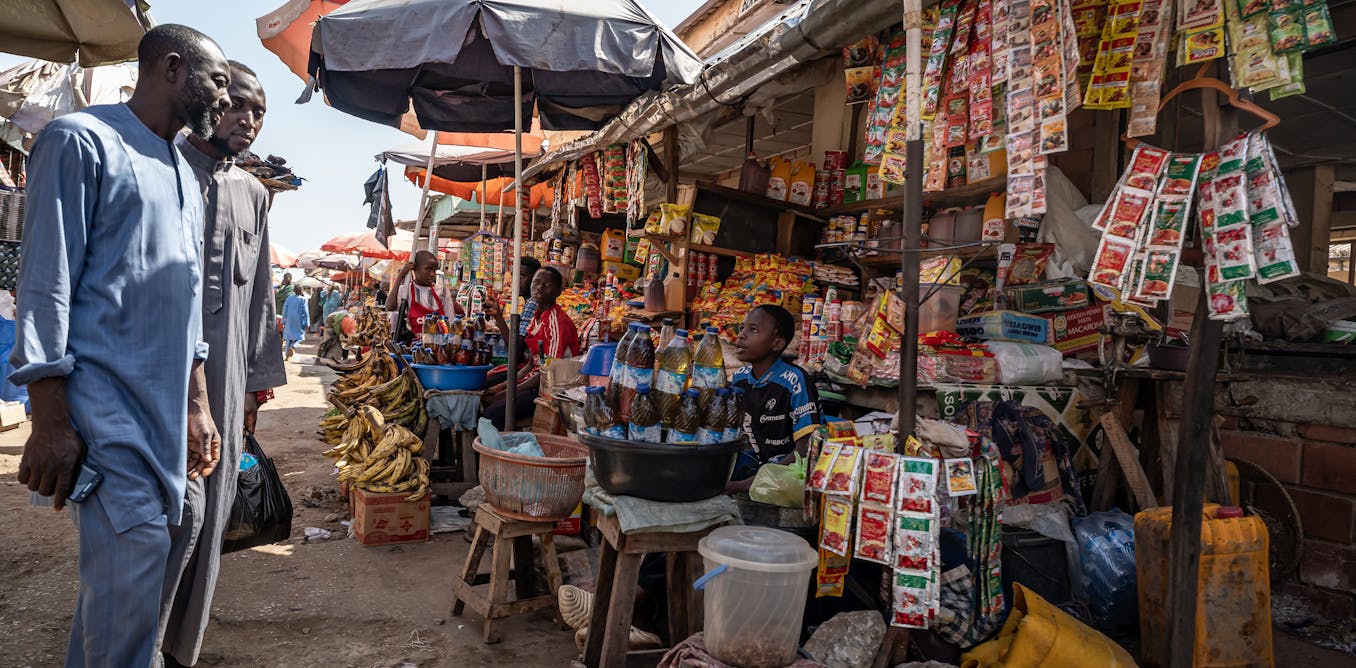
Because of the lack of jobs, about 93% are engaged in low-income informal sector activities. Public spaces and highways in the country have been taken over by roadside hawkers and other informal sector workers.
Nigerians are also chronically poor and food insecure. According to the World Bank, the number of poor people in Nigeria rose from 81 million in 2019 to 139 million in October 2025. Most have no safety net or means of protection from unforeseen events like illness, natural disasters or loss of jobs.
As an economist who has studied the Nigerian economy for over four decades, I argue that Nigeria needs a radical shift in its economic policy approach. Macroeconomic stability can’t be expected to automatically create jobs and alleviate poverty. Time and again, trickle-down economics has been shown to be a flawed economic philosophy.
It is time for the Tinubu administration to take decisive and unprecedented steps to translate macroeconomic improvements into better living conditions for Nigerians.
Why reforms aren’t feeding through
Most Nigerians have not felt the impact of improvements in macroeconomic performance because of the following:
Economic growth is not robust enough: Growth needs to be 6%-8% a year for at least five years, for most Nigerians to feel the impact of an improved economy. Much of that growth must come from labour-intensive sectors of the economy, particularly manufacturing and agro-processing.
Jobless growth: Employment-intensive sectors of the economy haven’t been affected by the reforms. The manufacturing sector, for instance, remains weak due to the high cost of imported raw materials, poor infrastructure, competition from cheap imported goods, and the high cost of borrowing.
Income stagnation and declines in real purchasing power: The few Nigerians with jobs have found that their income lags behind the rate of inflation. The fact that Nigeria’s inflation rate has fallen does not mean that prices have decreased. It simply means that prices are rising more slowly than they did before. And the minimum wage in Nigeria is one of the lowest in the world.
Non-inclusivity of growth: The gains from macroeconomic stability in Nigeria have not been broadly shared. There are two reasons. First, the main drivers of growth are sectors that are not labour-intensive: oil and gas, financial services, digital services, hospitality, music, art and design. Second, many Nigerians don’t have the skills and competencies to be employed in these sectors.
Perverse sectoral distribution of capital inflows: Although foreign capital has increased, much of it is portfolio investment in bonds, government treasury bills, and the stocks of financial institutions. The opportunities for employment generation are therefore very limited.
Economic challenges that need to be addressed
To translate recent policy reforms into better living standards, more needs to be done.
Job creation: The government should work with the private sector to resuscitate the manufacturing sector and agro-processing. Incentives should be given to foreign and domestic investors to invest in manufacturing and agro-processing. A rejuvenated manufacturing sector will integrate the Nigerian economy into global value chains.
Only about 2% of capital inflows this year is foreign direct investment. The rest is portfolio investment in government bonds and securities, as well as corporate stocks – especially in banking. Portfolio investment does not create jobs. Equity investment in manufacturing, agro-processing and even agriculture is preferable for job creation.
Cash transfers: Reduce the huge cost of running the country and use the savings for cash transfers for vulnerable Nigerians. Only about 8.4 million households (out of a population of 238 million) have received cash transfers of between N25,000 and N75,000. This is grossly inadequate. Giving more people cash would represent a big change for many Nigerians, no matter how small the transfer. Cash transfers that are paid for by a reduction in governance cost will not create inflation but enable Nigerians to invest in economic activities and be productive.
Public works: The government should accelerate the rate of job creation by using direct labour for targeted public works projects. Nigeria has many bad roads and dilapidated public buildings.
Streamline the foreign exchange market: There is still a gap between the official and parallel rates of exchange. There are many black-market foreign currency traders. In a well-functioning foreign exchange market, a sprawling black market should not exist.
Reduce the size of the informal sector: This can be done through the development of the manufacturing sector, which will draw surplus labour from the informal sector.
Economic development should be about people, their well-being and their economic dignity. While stabilising the economy, the government should intentionally put in place mechanisms to ensure that macroeconomic improvements result in better living conditions.
Stephen Onyeiwu does not work for, consult, own shares in or receive funding from any company or organisation that would benefit from this article, and has disclosed no relevant affiliations beyond their academic appointment.