The consulting firm Accenture recently laid off 11,000 employees while expanding its efforts to train workers to use artificial intelligence. It’s a sharp reminder that the same technology driving efficiency is also redefining what it takes to keep a job.
And Accenture isn’t alone. IBM has already replaced hundreds of roles with AI systems, while creating new jobs in sales and marketing. Amazon cut staff even as it expands teams that build and manage AI tools. Across industries, from banks to hospitals and creative companies, workers and managers alike are trying to understand which roles will disappear, which will evolve and which new ones will emerge.
I research and teach at Drexel University’s LeBow College of Business, studying how technology changes work and decision-making. My students often ask how they can stay employable in the age of AI. Executives ask me how to build trust in technology that seems to move faster than people can adapt to it. In the end, both groups are really asking the same thing: Which skills matter most in an economy where machines can learn?
To answer this, I analyzed data from two surveys my colleagues and I conducted over this summer. For the first, the Data Integrity & AI Readiness Survey, we asked 550 companies across the country how they use and invest in AI. For the second, the College Hiring Outlook Survey, we looked at how 470 employers viewed entry-level hiring, workforce development and AI skills in candidates. These studies show both sides of the equation: those building AI and those learning to work with it.
AI is everywhere, but are people ready?
More than half of organizations told us that AI now drives daily decision-making, yet only 38% believe their employees are fully prepared to use it. This gap is reshaping today’s job market. AI isn’t just replacing workers; it’s revealing who’s ready to work alongside it.
Our data also shows a contradiction. While many companies now depend on AI internally, only 27% of recruiters say they’re comfortable with applicants using AI tools for tasks such as writing resumes or researching salary ranges.
In other words, the same tools companies trust for business decisions still raise doubts when job seekers use them for career advancement. Until that view changes, even skilled workers will keep getting mixed messages about what “responsible AI use” really means.
In the Data Integrity & AI Readiness Survey, this readiness gap showed up most clearly in customer-facing and operational jobs such as marketing and sales. These are the same areas where automation is advancing quickly, and layoffs tend to occur when technology evolves faster than people can adapt.
At the same time, we found that many employers haven’t updated their degree or credential requirements. They’re still hiring for yesterday’s resumes while, tomorrow’s work demands fluency in AI. The problem isn’t that people are being replaced by AI; it’s that technology is evolving faster than most workers can adapt.
Fluency and trust: The real foundations of adaptability
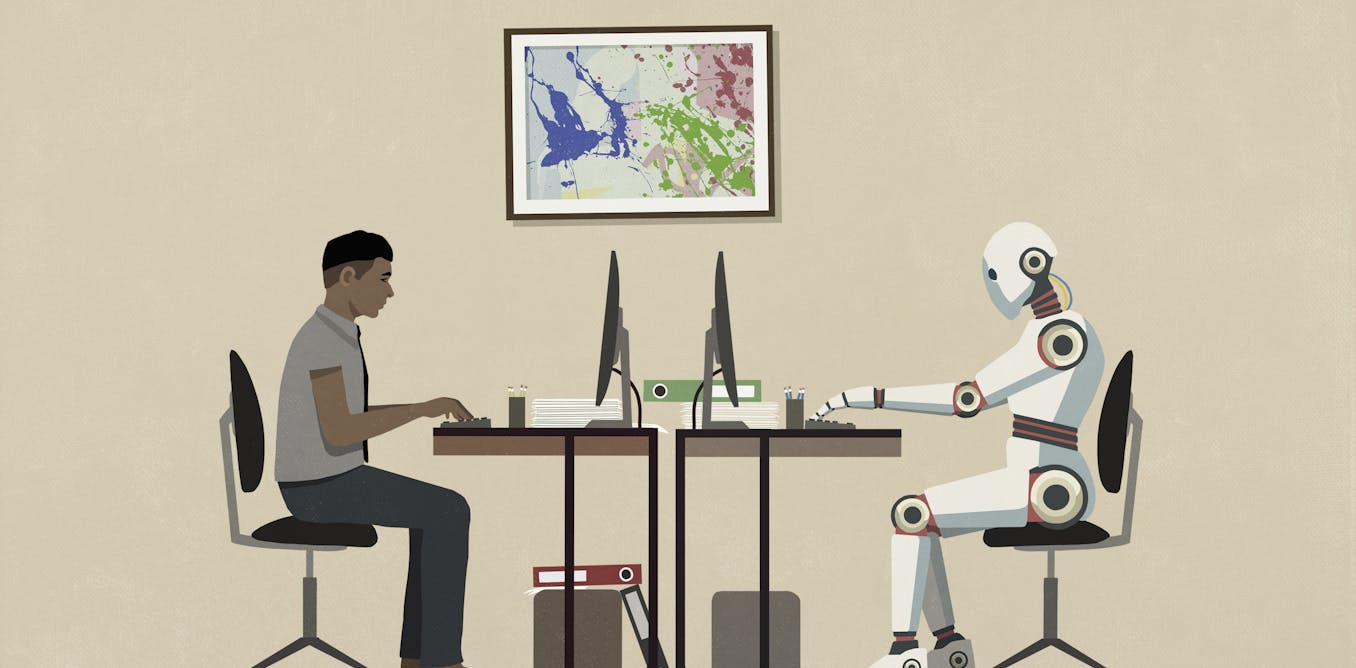
Our research suggests that the skills most closely linked with adaptability share one theme, what I call “human-AI fluency.” This means being able to work with smart systems, question their results and keep learning as things change.
Across companies, the biggest challenges lie in expanding AI, ensuring compliance with ethical and regulatory standards and connecting AI to real business goals. These hurdles aren’t about coding; they’re about good judgment.
In my classes, I emphasize that the future will favor people who can turn machine output into useful human insight. I call this digital bilingualism: the ability to fluently navigate both human judgment and machine logic.
What management experts call “reskilling” – or learning new skills to adapt to a new role or major changes in an old one – works best when people feel safe to learn. In our Data Integrity & AI Readiness Survey, organizations with strong governance and high trust were nearly twice as likely to report gains in performance and innovation. The data suggests that when people trust their leaders and systems, they’re more willing to experiment and learn from mistakes. In that way, trust turns technology from something to fear into something to learn from, giving employees the confidence to adapt.
According to the College Hiring Outlook Survey, about 86% of employers now offer internal training or online boot camps, yet only 36% say AI-related skills are important for entry-level roles. Most training still focuses on traditional skills rather than those needed for emerging AI jobs.
The most successful companies make learning part of the job itself. They build opportunities to learn into real projects and encourage employees to experiment. I often remind leaders that the goal isn’t just to train people to use AI but to help them think alongside it. This is how trust becomes the foundation for growth, and how reskilling helps retain employees.
The new rules of hiring
In my view, the companies leading in AI aren’t just cutting jobs; they’re redefining them. To succeed, I believe companies will need to hire people who can connect technology with good judgment, question what AI produces, explain it clearly and turn it into business value.
In companies that are putting AI to work most effectively, hiring isn’t just about resumes anymore. What matters is how people apply traits like curiosity and judgment to intelligent tools. I believe these trends are leading to new hybrid roles such as AI translators, who help decision-makers understand what AI insights mean and how to act on them, and digital coaches, who teach teams to work alongside intelligent systems. Each of these roles connects human judgment with machine intelligence, showing how future jobs will blend technical skills with human insight.
That blend of judgment and adaptability is the new competitive advantage. The future won’t just reward the most technical workers, but those who can turn intelligence – human or artificial – into real-world value.

Murugan Anandarajan does not work for, consult, own shares in or receive funding from any company or organization that would benefit from this article, and has disclosed no relevant affiliations beyond their academic appointment.