Press Nest Africa

Menu
  • Home
  • News
  • Business
  • Political Press
  • Government
  • NGOs
  • BRICS Forum
  • Voices / Opinions
Home News

News coverage boosts giving after disasters – Australian research team’s findings may offer lessons for Los Angeles fires

Africa Biz Watch by Africa Biz Watch
January 17, 2025
News coverage boosts giving after disasters – Australian research team’s findings may offer lessons for Los Angeles fires
Share on FacebookShare on Twitter

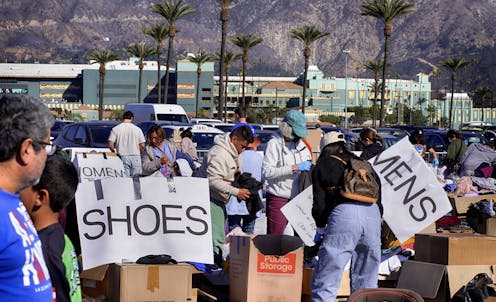
People who lost their possessions in the fire that swept through Altadena, Calif., look through donated shoes and clothing on Jan. 15, 2025. AP Photo/Richard Vogel

In late 2019 and early 2020, a series of devastating wildfires, known as the “black summer” bushfire disaster, left Australia reeling: More than 20% of the country’s forests burned.

As a scholar of the psychology of charitable giving, I have long been interested in the unique emotional response that disasters evoke – often generating an urgent and visceral wish to help.

RelatedPosts

SA extends condolences following Sydney terror attacks

Regulator studying court decision on publication of matric results

Traffic officers adopt a zero-tolerance stance towards bribery

SBI Holdings Joins Amar Bank as New Shareholder, Strengthening Global Confidence in Indonesia’s Digital Banking Sector

I wanted to understand how and why people respond to a crisis of this magnitude. For the project, I teamed up with three Australian environmental psychology and collective action experts: Matthew Hornsey, Kelly Fielding and Robyn Gulliver.

We found that international media coverage of disasters can help increase donations. Our findings, which were published in the peer-reviewed academic journal Disasters in 2022, are relevant to the situation in Los Angeles, where severe fires destroyed thousands of homes and businesses in January 2025, devastating many communities.

That recovery could take years.

5 key factors affect generosity

All told, Australian donors gave more than US$397 million, or $640 million in Australian dollars, to support the recovery from the black summer bushfire disaster. The international community also rallied: U.S. and U.K. donors contributed an additional US$2.6 million. These donations were used to fund evacuation centers, support groups for victims, and cash grants for repairs and rebuilding, among other things.

When we surveyed 949 Australians about what influenced their donations and analyzed news articles about the disaster, we found that coverage of disasters significantly increased generosity and influenced which charities drew donations. This may be because news articles communicated directly the need for charitable support.

Using this survey data, we identified key factors that influenced how much money, if any, people donated in response to the bushfire disaster appeals. These five were linked with the amounts Australians donated:

• Scale: The sheer scale of the fires.

• Personal impact: Having been personally affected, knowing people who have been affected, or being worried that they will be affected in the future.

• Climate change beliefs: Believing that climate change is impacting the environment.

• News footage: The dramatic footage of the fires they have seen.

• Stories: The stories of those who have been affected.

Three of these factors – scale, news footage and stories – relate to information people were exposed to in media coverage of the disaster. Further, when we asked people how they chose which charities to support, they said that media coverage was more influential than either their friends and family or direct communication from those same charities.

These findings collectively show how media coverage can powerfully influence both how much people give to disaster relief and which nonprofits they choose to support.

A man and a child stand amid wreckage that's been burned.
Bushfire survivor Ian Livingston and his son Sydney stand in the ruins of their family home, lost to the ‘black summer’ bushfires in May 2020 in Cobargo, Australia.
Brook Mitchell/Getty Images

Setting the agenda

In the next phase of our research, we tried to learn how media coverage affects the public’s generosity.

We downloaded every news article we could find about the disaster over the three-month period that fires raged and analyzed the text of 30,239 news articles using Linguistic Inquiry and Word Count software.

We looked at which kinds of language and concepts were being used in media coverage, and how frequently they were used compared with their use in everyday written language.

In addition to concepts we expected to see, like emergency, heroes and human loss, we found that the concepts of support and money frequently showed up in coverage. Words like “donations,” “help” and “support” occurred in 74% of news articles. Words having to do with money were even more common: They appeared almost twice as often as they do in ordinary written language.

Our findings suggest that news coverage may have helped to set the agenda for the huge charitable response to Australia’s wildfire disaster because the media told people what they should be thinking about in terms of that disaster. In Australia’s case, it was how they could help.

A consideration for the media

We also believe that it’s likely that news coverage of disasters like this one can serve an agenda-setting function by teaching the public how to think about the crisis.

To the extent that news coverage highlights concepts like support, possibly communicating that donating is a normal response to a crisis, it’s reasonable to expect people to donate more money.

Given that news coverage can influence how much someone donates, as well as which charities they choose to support, nonprofits responding to the Los Angeles fires may wish to encourage media outlets to mention their work in news coverage.

It is likely that being featured in news coverage – especially when calls to action or opportunities to donate are incorporated in an article – would result in more funds being raised for the charity’s response to the disaster.

The Conversation

Cassandra Chapman receives funding from the Australian Research Council.

Source link

Related Posts

SA extends condolences following Sydney terror attacks
News

SA extends condolences following Sydney terror attacks

December 14, 2025
Regulator studying court decision on publication of matric results
News

Regulator studying court decision on publication of matric results

December 14, 2025
Traffic officers adopt a zero-tolerance stance towards bribery
News

Traffic officers adopt a zero-tolerance stance towards bribery

December 14, 2025
SBI Holdings Joins Amar Bank as New Shareholder, Strengthening Global Confidence in Indonesia’s Digital Banking Sector
Corporate News from Media OutReach Newswire

SBI Holdings Joins Amar Bank as New Shareholder, Strengthening Global Confidence in Indonesia’s Digital Banking Sector

December 13, 2025
World-leading Economists and Thought Leaders Converge at Hong Kong’s Landmark Forum to Decode China’s Economic Future in a Multipolar World
Corporate News from Media OutReach Newswire

World-leading Economists and Thought Leaders Converge at Hong Kong’s Landmark Forum to Decode China’s Economic Future in a Multipolar World

December 13, 2025
BingX Academy Launches Dedicated Education Hub for Tokenized Stocks (XStocks)
Corporate News from Media OutReach Newswire

BingX Academy Launches Dedicated Education Hub for Tokenized Stocks (XStocks)

December 13, 2025
Corporate News from Media OutReach Newswire

ACES Awards 2025 Honours Philippine Organisations Driving National Resilience and Inclusion

December 13, 2025
Hualien Unveils “We Bloom!” for 2025, Marking a Full Revival of Tourism
Corporate News from Media OutReach Newswire

Hualien Unveils “We Bloom!” for 2025, Marking a Full Revival of Tourism

December 13, 2025
Next Post
Loadshedding remains suspended for 282 days with year-on-year diesel savings of R16.52 billion achieved

Structural performance change continues to deliver ongoing suspension of loadshedding for over nine months to support socio-economic growth; diesel usage remains below the year-to-date budget

How do you create a workplace that people want to work in? We embedded in a company to find out

How do you create a workplace that people want to work in? We embedded in a company to find out

Neighbors and strangers pulled together to help LA fire survivors – 60 years of research shows these unsung heroes are crucial to disaster response

Neighbors and strangers pulled together to help LA fire survivors – 60 years of research shows these unsung heroes are crucial to disaster response

Loadshedding remains suspended for 282 days with year-on-year diesel savings of R16.52 billion achieved

Loadshedding suspension reaches 300 days – over nine months, to deliver energy security and inclusive socio-economic growth

I’m an economist. Here’s why I’m worried the California insurance crisis could trigger
broader financial instability

I’m an economist. Here’s why I’m worried the California insurance crisis could trigger broader financial instability

Recommended.

OPPO Announced Apex Guard, Reaffirming its Commitment to Next-Level Quality

OPPO Announced Apex Guard, Reaffirming its Commitment to Next-Level Quality

November 14, 2025
Extreme weather’s true damage cost is often a mystery – that’s a problem for understanding storm risk, but it can be fixed

Extreme weather’s true damage cost is often a mystery – that’s a problem for understanding storm risk, but it can be fixed

June 4, 2025

Trending.

No Content Available

Publish News, Boost Your PR, SEO, and Business Exposure with SagloMedia's Dedicated Brand Sections

Discover More

News Publications

  • EBNewsDaily
  • South African Business News
  • BetsBulletin SA
  • PressNest
  • EconoNews
  • AfricaBiz Watch

Listing Directories

  • MySouthy
  • BizFinder Directory
  • ListBig
  • SA Companies
  • OutingPlace
  • Rental Kings

Quick Links

  • Home
  • Advertise
  • Publications
  • Company News
  • Privacy Policy
  • Copyright & Takedowns

SagloMedia

  • About us
  • Careers
  • Student Program
  • RSS Feeds
  • Press Code
  • Contact Us

Get In Touch

  • info@saglomedia.co.za
  • Tel: +27 10 880 3950
  • WhatsApp: +27 10 880 3950
  • Johannesburg, South Africa
  • SagloMedia
  • www.saglomedia.co.za
Copyright © 2025 | SagloMedia

Saglohost Web Hosting | Web Hosting South Africa | Web Design Johannesburg | Web Design South Africa | Saglotech | Web Design Company | SEO Company South Africa | SEO Company Johannesburg